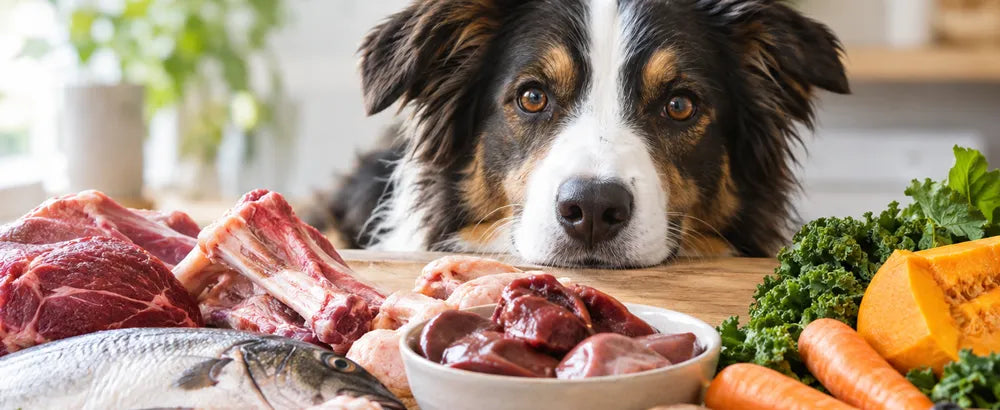
Raw feeding can be a wonderful way to offer dogs a varied and interesting diet — but, as with everything we feed our dogs, safety comes first.
Every dog is different. Some are careful chewers, while others are enthusiastic gulpers! Knowing your dog and choosing foods that are appropriate for their size, chewing style and individual needs is essential.
Meaty Bones
If your dog is not a gulper, appropriately sized raw meaty bones can be included in the diet, always with supervision.
The key words here are appropriate, raw and supervised.
My go-to BARF bones
Some of my favourite choices include:
- Whole rabbits
- Duck wings
- Duck necks
- Chicken frames
- Quails
- Silkie chickens
- Turkey necks
- Turkey wings - sometimes, depending on the dog
- Chicken feet
- Chicken wings
- Lamb shoulder blades
- Lamb briskets
- Salmon heads
- Fish frames
My basic bone-safety rules
- Bones should always be fed raw, never cooked.
- Avoid very hard, dense, weight-bearing bones from large animals
- As a general rule, I prefer bones from smaller animals or softer bones that are appropriate for the individual dog
- Always supervise your dog while they are eating a bone
- Never assume that a bone is safe simply because another dog eats it successfully
Very hard bones can damage teeth, while larger pieces can potentially cause choking, obstruction or digestive problems.
For example:
- Rabbit legs are generally much softer and easier to manage
- Large, dense lamb leg bones can be much harder and may pose a greater risk of dental injury
Why does bone choice matter?
Too much or inappropriate bone can contribute to:
- Fractured or damaged teeth
- Constipation
- Gastrointestinal obstruction
- An excessive amount of calcium and bone in the diet
And there is another very useful thing to watch: your dog's poo!
If stools become very pale, white, dry or crumbly, this can be a sign that there is too much bone in the diet.
The goal is not simply to feed "more bone" — it is to find the right balance for the individual dog.
ORGANS
When we talk about organs in BARF, we generally mean the nutrient-rich secreting organs rather than every piece of internal tissue.
Commonly used organs
These can include:
- Liver
- Spleen
- Kidneys
- Brain
- Pancreas
- Other secreting tissues
They provide a concentrated source of important vitamins, minerals and other nutrients and therefore should be included thoughtfully rather than simply added in large quantities.
What about lungs, stomach and tripe?
Not every internal organ is nutritionally equivalent to liver, kidney or spleen.
Foods such as:
- Lungs
- Stomach
- Green tripe
- Other non-secreting tissues
can absolutely be useful additions to a varied diet, but I generally think of them as meat or additional variety rather than replacing the nutrient-dense organ portion.
The important thing is to look at the diet as a whole rather than focusing on one ingredient in isolation.
And what about heart?
Heart is technically muscle tissue, rather than an organ in the nutritional sense.
But I love using it!
Heart is a particularly useful ingredient to rotate through the diet and is a valuable source of nutrients including taurine.
So, even though I count it as muscle meat, it definitely deserves a regular place in the bowl.
Tongue — the "joker" cut
Tongue is one of those ingredients that makes BARF conversations interesting!
It is made primarily of muscle, although it contains glandular tissue too, so people don't always agree on exactly where it belongs.
Personally, I treat tongue as a "joker" food.
It is:
- Nutrient-rich
- Very palatable for many dogs
- A lovely addition to a varied rotation
So if you can find good-quality tongue, I am very happy to see it in the bowl.
FRUITS, VEGETABLES, HERBS, SEEDS & NUTS
When it comes to plant foods, my biggest recommendation is very simple:
Choose variety and, whenever possible, seasonal produce.
Seasonal fruit and vegetables are often:
- Fresher
- More readily available
- More affordable
- A great way to introduce variety into the diet
I like thinking of plant foods as extras that add variety, rather than as the foundation of a dog's diet.
And, as always, the amount and type should be appropriate for the individual dog.
HERBS — LITTLE NUTRIENT BOOSTERS
I absolutely love adding small amounts of fresh herbs.
They can provide flavour and a variety of plant nutrients and are a lovely way to keep meals interesting.
Some of my favourites are:
- Coriander
- Parsley
- Basil
- Oregano
- Rosemary
I prefer to rotate them rather than giving large quantities of one particular herb every day.
FRUIT
When it comes to fruit, berries are some of my favourites.
They are easy to add in small quantities and provide a variety of vitamins and plant compounds.
Some dogs also enjoy small amounts of:
- Blueberries
- Strawberries
- Raspberries
- Blackberries
I also enjoy adding mushrooms when appropriate, especially when they are fresh and in season.
As with all plant foods, small amounts and variety are the key.
CARROTS & PUMPKIN
I do like seeing small amounts of carrots and pumpkin in the diet.
They can provide fibre and variety, but there is no need to go overboard.
I prefer to think of them as supporting ingredients rather than a major component of the bowl.
Too much of any one plant ingredient can unnecessarily displace other nutritionally important foods.
SEEDS & NUTS
Seeds and nuts can be interesting additions to a varied feeding plan, but they should be used in small quantities and rotated, rather than becoming a major part of the diet.
Prepare seeds properly
For seeds that benefit from soaking, I like to:
- Soak them in room-temperature water
- Leave them for several hours or overnight
- Then blend, crush or finely process them before feeding
This can make them easier for dogs to digest.
Some of my favourite additions
I like rotating different seeds and nuts, for example:
- Pepita seeds
- Sunflower seeds
- Walnuts
- Almonds
- Brazil nuts
- Chia seeds
- Sesame seeds
- Poppy seeds
But remember: more is not better.
Nuts and seeds are calorie-dense, and some can contain compounds that make them less suitable.
One important exception
Macadamia nuts should never be fed to dogs.
They are toxic to dogs.
PREPARING PLANT FOODS
Fruits, vegetables, mushrooms, seeds and herbs should be:
- Properly washed
- Prepared in a way that is appropriate for the individual ingredient
- Finely chopped, crushed or blended when this improves digestibility
Dogs do not process plant cell walls in the same way humans do, so appropriate preparation can make plant ingredients easier to utilise.
And, of course, always check that an ingredient is safe for dogs before adding it.
FISH
Fish is a fantastic ingredient to rotate through a dog's diet.
I particularly like oily fish, because they are naturally rich in long-chain omega-3 fatty acids such as EPA and DHA. Fish can also contribute important nutrients including vitamin D.
My favourite fish choices
Some of my favourites are:
- Sardines
- Mackerel
- Salmon
- Anchovies
I generally like smaller fish, particularly species that are lower on the food chain, as a practical way of reducing exposure to contaminants.
But real life matters too!
The most important thing is to choose good-quality fish that is realistically available to you and to maintain variety rather than relying on one species all the time.
WHAT IF YOUR DOG DOESN'T TOLERATE OILY FISH?
Some dogs simply don't do well with very fatty fish.
You may notice:
- Softer stools
- Digestive upset
- Reduced tolerance of the meal
If this happens, you can try:
- Reducing the quantity
- Feeding it less frequently
- Choosing a leaner fish
- Using a different preparation
Sometimes a gently cooked white fish is simply a better option for an individual dog.
There is no prize for forcing an ingredient that doesn't agree with your dog!
RAW FISH SAFETY
Raw fish requires some extra care.
Freezing can be used as part of parasite-control practices for certain fish, but freezing does not make raw food sterile and does not eliminate all bacteria.
For this reason, always follow the appropriate freezing guidance for the specific fish, source and intended use, and use reputable suppliers.
Good hygiene is just as important:
- Keep raw fish refrigerated or frozen as appropriate.
- Keep it separate from other foods.
- Wash hands and utensils after handling.
- Clean preparation surfaces properly.
- Don't leave uneaten raw food sitting out.
Raw diets can carry bacteria such as Salmonella and Listeria, so careful handling is particularly important in households with children, elderly people, pregnant people or anyone immunocompromised.
OTHER FISH OPTIONS
You don't always have to buy fresh fish.
I am also perfectly happy to see clients using:
- Frozen fish
- Canned fish
If you use canned fish, choose a product appropriate for dogs and check the ingredients carefully.
If it is packed in brine, rinsing it can help remove some of the surface salt — but I would generally prefer fish packed in water with no added salt where available.
THE MOST IMPORTANT THING
Raw feeding should never be about following a rigid list of ingredients.
It should be about balance, variety, quality and understanding your individual dog.
A healthy raw diet needs to provide the right nutrients in the right proportions — not simply a collection of healthy-looking ingredients. Homemade diets can easily become unbalanced, particularly in minerals such as calcium and phosphorus, so formulation matters.
And finally, remember that raw does not automatically mean safe.
Good sourcing, correct preparation, appropriate portions, hygiene and sensible food choices are all part of responsible raw feeding.